Neighbors, we need to talk.
Right now, as you’re reading this, developers are circling our neighborhood like vultures. They see our modest homes, the ones we’ve maintained and loved, and they don’t see us. They see dollar signs. They see “opportunity.” They see a land grab.
What they DON’T see are the people who make Stringtown a community. What they DO see is non-neighbors who speak on behalf of our neighborhood to support this destruction, and it has got to stop!
The Threat Is Real and It’s Happening Now
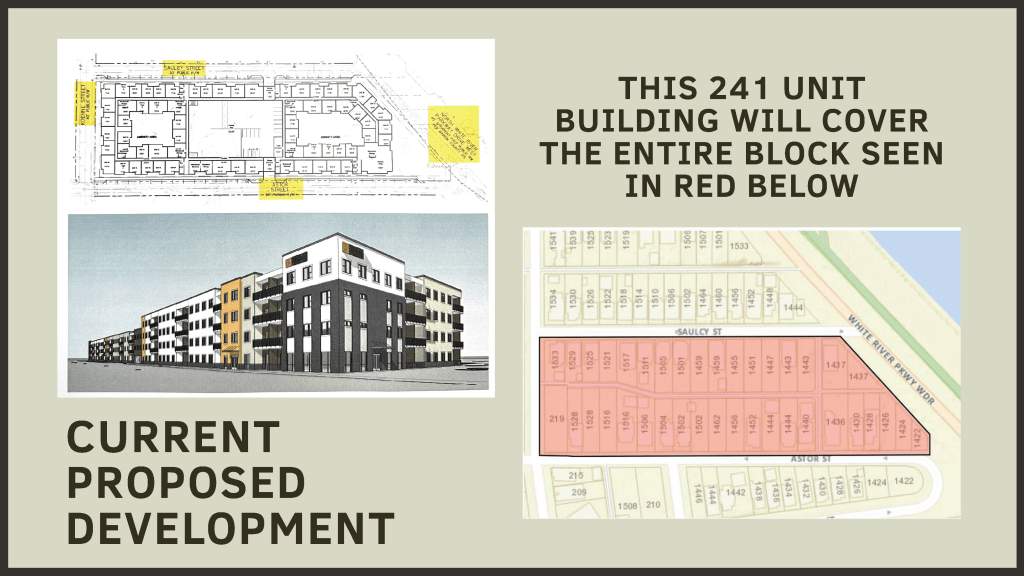
Brougher Developments is actively planning to tear down the remaining homes on Saulcy and Astor Streets for so-called “redevelopment.” According to their own ad on this commercial real estate website, and as you can see from their own rendering below, they’re envisioning high-rises, hotels, and luxury condos with “rooftop decks and views of the White River, the Indianapolis Zoo, and downtown Indianapolis skyline.”
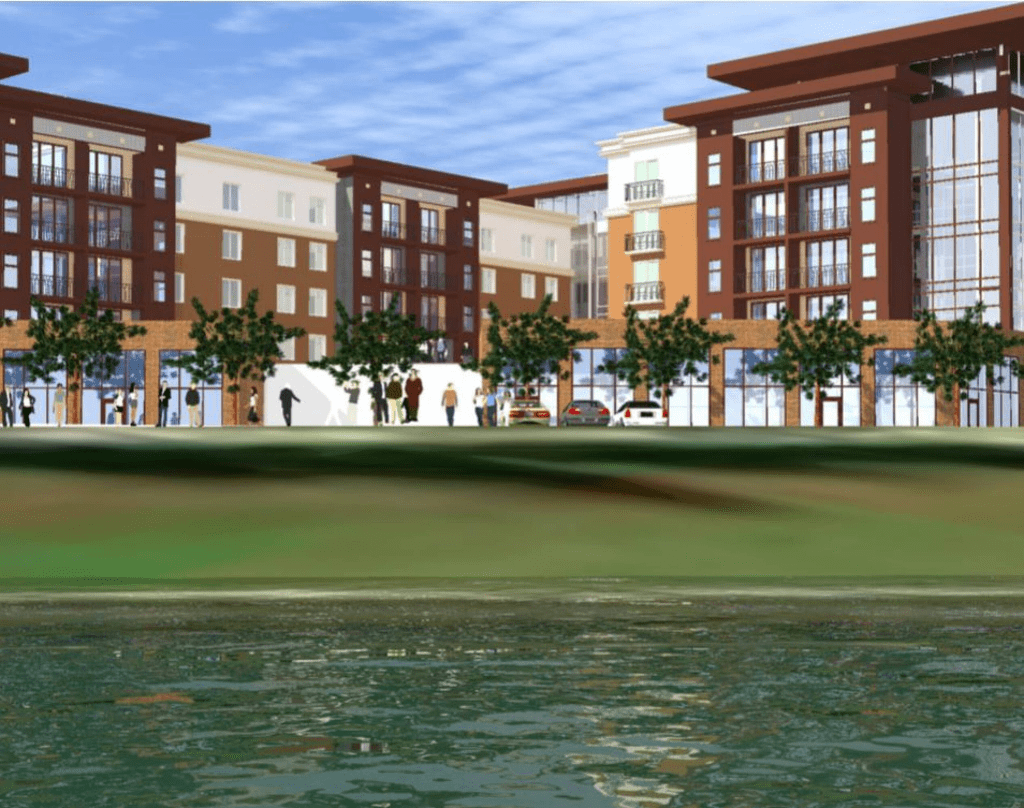
Sounds nice, right? Except for one problem: none of that is for us.
The developer’s own plans call for homes priced between $250,000 and $350,000. Let’s be clear about what that means. The current median home price in Stringtown is around $149,900, which is already a stretch for most of us. Yet, these new developments would cost MORE THAN DOUBLE that.
So who exactly are these homes for? Certainly not the poor and working-class people who maintain and give life to this neighborhood with their own hands. AKA certainly not for us!
When Churches Become Developers
It’s not just outside developers, either. The Westside Apostolic Pentecostal Church in our own neighborhood is also tearing down perfectly good single-family homes to expand their church facilities.
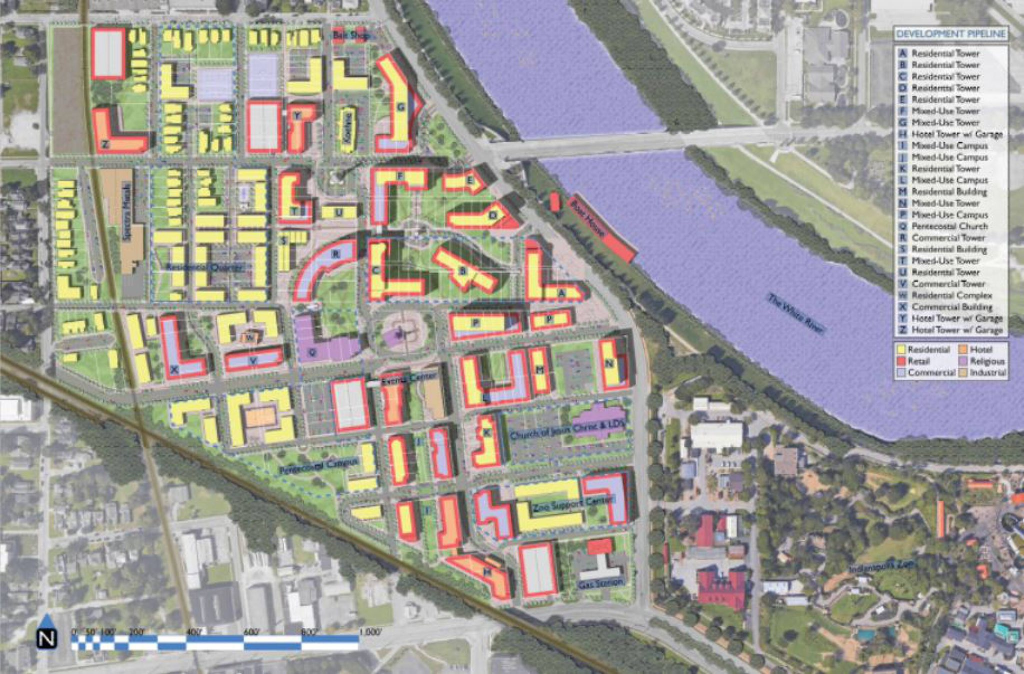
We respect people’s faiths and their right to worship. However, when a church tears down affordable single-family homes in a neighborhood that desperately needs them, we have to ask some hard questions. What does it say about our society’s values when even our places of worship prioritize profit and expansion over keeping roofs over our neighbors’ heads?
The Bible talks a lot about caring for your neighbor. About not displacing the vulnerable. About justice for the poor. Tearing down homes people could be living in? That doesn’t square with those values, no matter how nice the new building looks.
What makes this so much more insidious and so much more un-Christian is the fact that neither the pastor, nor the vast majority of the churchgoers are our neighbors. We will just have to pray for them and keep fighting for Stringtown.
We’ve Seen This Story Before
If you think we’re being dramatic, let’s look at what’s happened in other Indianapolis neighborhoods. History is trying to repeat itself, and we need to learn the lessons before it’s too late.
The IUPUI Disaster
Just a stone’s throw from Stringtown, Indiana University systematically destroyed an entire thriving Black neighborhood to build what became IUPUI. From the 1960s to the 1980s, the university acquired around 300 acres of land, buying home after home (for what neighbors widely believed to be unfair prices) and driving Black residents out.
This wasn’t just any neighborhood. This was Indiana Avenue, Indianapolis’ “Black Wall Street.” It had grocery stores, barber shops, salons, doctors, dentists, restaurants, and jazz clubs. It was a self-sufficient, thriving community where families had lived for generations.
The university used eminent domain to force people out of homes their families had built with their own hands. One family, the Temples, fought for over a decade to keep their home, a house built in the late 1800s by one of Indianapolis’ first Black police officers. The university eventually seized it using eminent domain and paid them $50,000 for properties they’d valued at $98,000.
Today, where thriving homes once stood, there are parking garages and university buildings. Where children once played in courtyards, there’s empty concrete. Where neighbors once took care of each other, there’s… nothing.
One former resident, David Rasheed, returned home after military service to find his entire childhood erased. “When we left Minerva Street,” he remembered, “you could see all the way from North Street to New York Street, because all the houses were gone.”
Lockefield Gardens or When “Improvement” Means Removal
Lockefield Gardens was Indianapolis’ first public housing complex, completed in 1938. It wasn’t a “slum,” it was a village where families looked out for each other, where kids played together in courtyards, where Oscar Robertson learned to play basketball.

When the complex needed repairs in the 1970s, residents voted for a $5.5 million renovation plan. They wanted to save their community. Instead, the city closed Lockefield and by July 1983, most of Lockefield’s buildings were torn down. Former residents gathered to watch, and one remembered it “was like a funeral.”
What replaced it? Apartments marketed to college students and hospital employees (hm, sounds familiar!). The new Lockefield opened in 1987, but the families who’d built the community were long gone, scattered across the city, and their neighborhood erased from the map.
Martindale-Brightwood and the Rebranding Game
In other Indianapolis neighborhoods, developers have played a different game: rebranding. Rename a historically Black neighborhood something trendy like “Monon16” to attract new (read: whiter, wealthier) residents.
As one 77-year-old resident told the Indianapolis Recorder: “Don’t tell Pearl Carter she lives in the Monon16 neighborhood. That’s a ploy, she said, to attract new—mostly white—people and businesses.” She lives in Martindale-Brightwood, and she’s watched her community be gentrified right out from under her.
What “Redevelopment” Really Means
Let’s call this what it is: displacement dressed up in pretty language.
When developers talk about “revitalization” and “redevelopment,” here’s what they mean:
- Tearing down affordable homes to build expensive ones
- Pricing out current residents so wealthier people can move in
- Erasing the history and culture of poor and working-class neighborhoods
They’ll tell you it’s “progress.” They’ll show you glossy renderings of modern buildings and manicured parks (ahem, see above). They’ll promise “mixed-income” housing, and spoiler alert! There are never enough affordable units, and they’re always the first to go.
What they won’t tell you is that “mixed-income” is often code for “we’ll let a few poor people stay so we can check some boxes for a while, but mostly this is for people who can afford $300,000 condos.”
They won’t tell you that once property values shoot up, long-time homeowners get priced out by property taxes they can no longer afford.
They won’t tell you that “revitalization” almost always means the people who made the neighborhood worth living in are pushed out to make room for people who can pay more.
Why Stringtown Is in the Crosshairs
Developers aren’t targeting Stringtown by accident. We’re in their sights because:
- Location, location, location! We’re right next to White River State Park, walking distance to downtown, near IUPUI (now IU Indianapolis), close to the Zoo. That’s prime real estate.
- We’re “surrounded.” As developer materials note, we’re near 16 Tech, the former Central State Hospital site, and the former GM stamping plant. They see us as the missing piece in their downtown expansion puzzle.
- We’re vulnerable. Our neighborhood is poor and working-class. Many residents don’t have the resources to fight expensive legal battles. Developers know this and they count on it.
- The playbook works. They’ve done this before in other Indianapolis neighborhoods and gotten away with it. Why wouldn’t they try it again?
We’re not against growth. We’re not against nice things. We’re against being erased from our own neighborhood.
Environmental Justice (Again)
Remember our recent post about environmental justice? This is all connected.
Poor neighborhoods and communities of color don’t just get stuck with the pollution and the trash dumps. They also get targeted for displacement when their location suddenly becomes “desirable” to developers.
It’s a cruel double standard. When our neighborhoods are struggling, we’re ignored and under-resourced. When developers see dollar signs, suddenly there’s plenty of money. But not for us. Instead, it’s for the people who’ll replace us.
The same communities that have been historically denied resources, subjected to redlining, and left to deal with environmental hazards are now being told they’re not good enough to stay in their own neighborhoods.
That’s not justice. That’s violence.
This is OUR Neighborhood
The good news is that we are not powerless. History shows us what happens when neighbors don’t fight back, but it also shows us that organized communities can push back against displacement. Some things you can start doing today…
1. Show Up and Speak Up
- Attend every council and public hearing meeting (contact us to go as a group!)
- Hang signs in your windows and anywhere you can! “DEVELOPERS OUT OF STRINGTOWN”; “STOP THE DESTRUCTION OF STRINGTOWN”
- Write our councilor, Kristin Jones, and demand that she stop supporting developers and start protecting neighbors and their right to affordable single-family homes
2. Document Everything
- Take photos of the homes developers want to tear down and show they’re NOT “blighted”
- Record the history of who lives here and for how long
- Save all notices about development proposals
- Share information with neighbors who might not know what’s happening
3. Build Alliances
- Connect with other Indianapolis neighbors fighting displacement
- Reach out to tenant rights organizations and housing advocacy groups
- Form a Stringtown anti-displacement coalition
4. Know Your Rights
- Learn about eminent domain laws in Indiana
- Understand your property rights
- Get legal advice (some organizations offer free legal clinics for housing issues; check out the legal resources at the bottom of our previous post about mutual aid)
5. Make Noise
- Contact Mirror Indy and other local media to tell our story
- Use social media to share what’s happening in Stringtown
- Make sure people know this isn’t just “development” (it’s displacement!)
- Don’t let developers control the narrative!
A Message to the Developers
To Brougher Developments and any other company, church, etc. eyeing our neighborhood:
We see you. We know what you’re planning. And we’re telling you right now: we’re not going quietly.
You can draw up all the fancy renderings you want. You can talk about “revitalization” and “bringing investment to the area.” But we know the truth. You want to erase us so you can profit from our location.
We won’t let you write us out of our own story.
Every home you want to tear down is someone’s history. Someone’s memories. Someone’s stability. You don’t get to erase that without a fight.
A Message to Our Neighbors
For generations, Stringtown has survived floods, economic downturns, neglect, and discrimination. We’ve survived because we’ve refused to give up on this place we call home.
Now is not the time to stop fighting.
Your home matters. Your history matters. Your family’s roots in this neighborhood matter. You are not “in the way” of progress. You ARE Stringtown.
Stand with us. Fight with us. Let’s make sure that in 10 years, 20 years, 50 years, Stringtown is still a place where poor and working-class families can live comfortably and without the constant threat of displacement. Where neighbors matter more than profit and condos.
This Is About More Than Buildings
At the end of the day, this fight isn’t really about houses. It’s about people. It’s about the right to stay in the community you’ve built, invested in, and loved. It’s about saying that poor and working-class families deserve stable, affordable housing in the city they call home.
It’s about rejecting the idea that everything and everyone is for sale to the highest bidder.
It’s about remembering that before developers saw “opportunity,” we saw HOME.
Stringtown is not for sale. We are not for sale.
In solidarity,
Your Stringtown Now Neighbors
Have information about development plans affecting Stringtown? Witnessed property acquisitions? Have ideas for fighting displacement? Contact us or post in the comments. Together, we’re stronger


Leave a reply to Ana Martz Cancel reply